Golf simulators for a low ceiling
The short answer
Ceiling height decides more purchases in this category than budget does, and the constraint is not the same for every unit. Overhead sensors calibrate inside a height band, so they can fail a ceiling for being too high as well as too low. Sensors that sit beside the ball impose no ceiling requirement of their own at all.
| Launch monitor | Sits | Sensor | Ceiling | Room depth | Price | |
|---|---|---|---|---|---|---|
| Garmin Approach R10 | Behind the ball | Radar | — | 15 ft | $600 | Check price |
| FlightScope Mevo+ | Behind the ball | Radar | — | 16 ft | — | Check price |
| SkyTrak ST MAX | Beside the ball | Camera plus radar | — | 13 ft | $1,995 | Check price |
| SkyTrak SkyTrak+discontinued | Beside the ball | Camera plus radar | — | 13 ft | $1,995 | Check price |
| Uneekor EYE XO2 | Overhead | Camera | — | — | — | Check price |
| Foresight Sports GC3 | Beside the ball | Camera | — | 13 ft | $6,999 | Check price |
| Full Swing KIT | Behind the ball | Radar | — | 19 ft | $4,999 | Check price |
| Foresight Sports GCHawk | Overhead | Camera | — | — | $9,498 | Check price |
| Foresight Sports GCQuad | Beside the ball | Camera | — | 13 ft | — | Check price |
| Bushnell Launch Pro | Beside the ball | Camera | — | 13 ft | — | Check price |
| TrackMan 4 | Behind the ball | Radar | — | — | $25,995 | Check price |
| Garmin Approach R50 | Beside the ball | Camera | — | 13 ft | $5,000 | Check price |
| Uneekor EYE MINI | Beside the ball | Camera | — | 13 ft | $2,999 | Check price |
| Uneekor EYE XR | Overhead | Camera | — | — | $5,999 | Check price |
| Rapsodo MLM2PRO | Behind the ball | Camera plus radar | — | 15 ft 6 in | $700 | Check price |
Room depth is the minimum this unit can work in, counting clearance behind the screen, ball flight and the space the sensor itself needs. A dash means the maker does not publish that figure, never that we guessed it. Each unit’s page lists its sources and the date they were read.
A typical room of this type
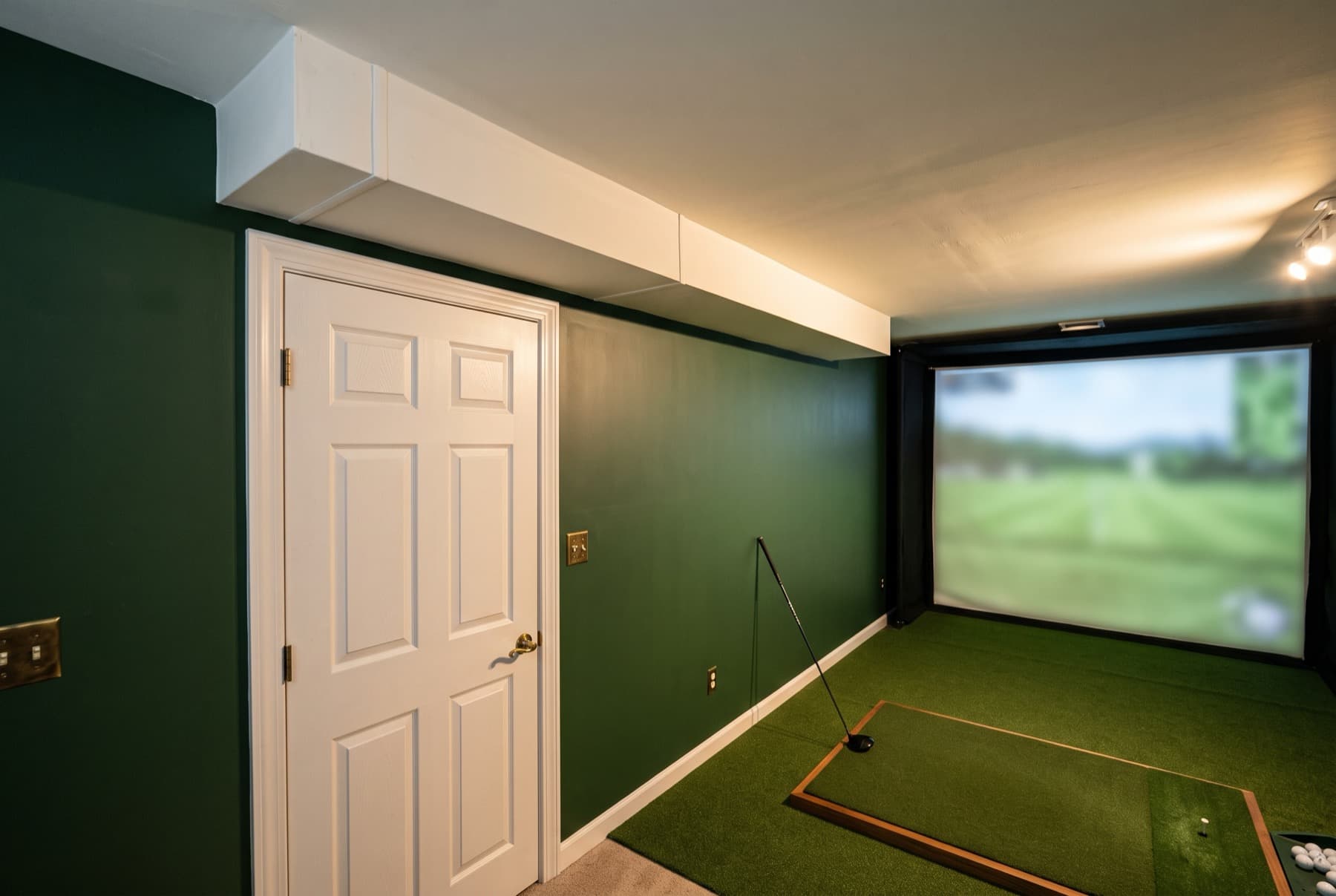
Run against 16 ft deep by 14 ft wide with a 8 ft ceiling, 13 of the 14 launch monitors we could check will work. The ones that fail are overhead units, which mount inside a fixed height band this room sits below. Yours will differ, and the ceiling especially, so put your own numbers in.
What to check before you commit
Measure with a club, not a tape
Hold a driver at the top of your actual backswing and have someone measure to the club head. Swing arc varies with height and with how upright your swing is, and the generic figures are only a starting point.
Decide what you are giving up before you buy
At eight feet the driver goes first. Irons and short game are largely unaffected, so a low room is a real practice space even when it is not a full one. Going in knowing that is the difference between a good purchase and a disappointment.
Rule out overhead sensors early
They mount inside a fixed height band and a low ceiling sits below it. Narrowing to sensors that sit beside the ball first saves comparing units you cannot install.
What to avoid
- Buying an overhead unit for a room under nine feet without checking the mount band.
- Assuming a taller golfer will manage. Swing arc scales with height almost directly.
- Building at under eight feet at all. We do not rank anything below it, and that is not caution.
Check it against your room
Eight feet is the height at which the choice of sensor stops being optional.
Loading the calculator.
Keep reading
Room fit calculator
Check your own ceiling, depth and width against every unit
Room size guide
The three distances that add up to room depth
What it costs
Sensor, enclosure, projector and the subscription after
Complete packages
Sensor, enclosure, screen and mat in one purchase
Under $5,000
Complete builds that land under five thousand
Under $10,000
Where a better sensor starts to be the upgrade
Common questions
What is the minimum ceiling height for a golf simulator?+
We treat 8 ft as the floor. Below that we mark every full-swing product as no fit rather than rank a room that cannot hold a simulator. Nine feet is where most golfers stop noticing the ceiling.
Can a ceiling be too high for a launch monitor?+
For overhead units, yes. They calibrate inside a mount-height band, so a ceiling above the band needs a drop pole or extender mount to bring the sensor into range. That is a solvable problem rather than a reason to rule the unit out.
Will a low ceiling damage my clubs?+
It can. A driver at the top of the backswing is the club most likely to reach the ceiling, and hitting a joist mid swing is how shafts get bent. This is the practical reason we do not rank anything below eight feet.
Do shorter golfers need less ceiling height?+
Yes, and it is worth measuring rather than assuming. The club head reaches roughly three to four feet above your head at the top of the swing, so height difference between golfers translates almost directly into ceiling requirement.