Basement golf simulators
The short answer
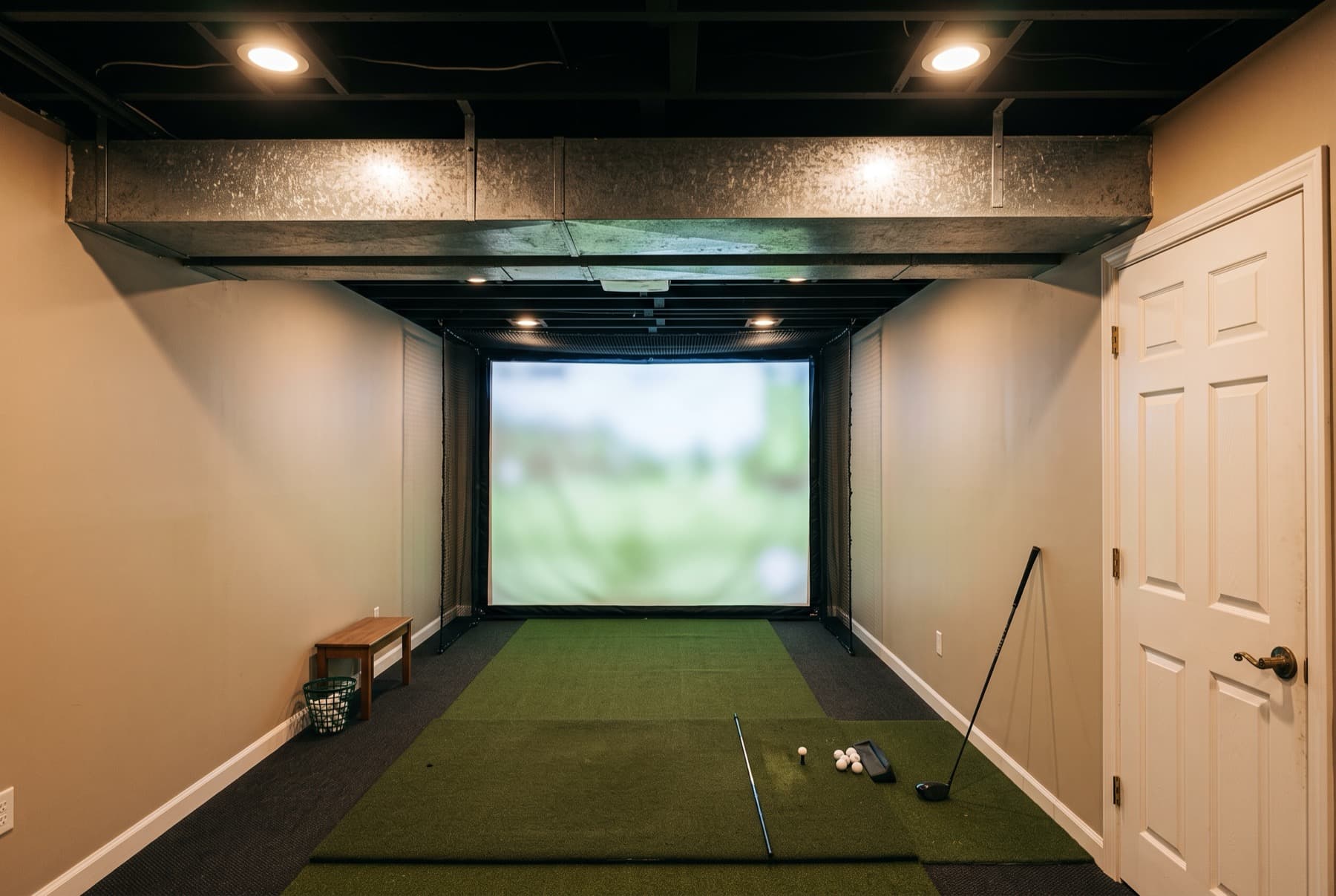
Basements usually have the depth and lose on height. Ducts, beams and joists set the real ceiling, and they are almost always lower than the finished ceiling you measured. This is the room type where the choice of launch monitor matters most.
| Launch monitor | Sits | Sensor | Ceiling | Room depth | Price | |
|---|---|---|---|---|---|---|
| Garmin Approach R10 | Behind the ball | Radar | — | 15 ft | $600 | Check price |
| Uneekor EYE XO | Overhead | Camera | 9 ft or more | 13 ft | $6,499 | Check price |
| TrackMan iO | Overhead | Camera plus radar | 8 ft 10 in to 10 ft 6 in | 15 ft | $9,500 | Check price |
| ProTee VX | Overhead | Camera | 9 ft to 10 ft | 13 ft | $6,500 | Check price |
| FlightScope Mevo+ | Behind the ball | Radar | — | 16 ft | — | Check price |
| SkyTrak SkyTrak+discontinued | Beside the ball | Camera plus radar | — | 13 ft | $1,995 | Check price |
| Rapsodo MLM2PRO | Behind the ball | Camera plus radar | — | 15 ft 6 in | $700 | Check price |
| Uneekor EYE XO2 | Overhead | Camera | — | — | — | Check price |
| TrackMan 4 | Behind the ball | Radar | — | — | $25,995 | Check price |
| SkyTrak ST MAX | Beside the ball | Camera plus radar | — | 13 ft | $1,995 | Check price |
| Foresight Sports GC3 | Beside the ball | Camera | — | 13 ft | $6,999 | Check price |
| Full Swing KIT | Behind the ball | Radar | — | 19 ft | $4,999 | Check price |
| Foresight Sports GCHawk | Overhead | Camera | — | — | $9,498 | Check price |
| Foresight Sports GCQuad | Beside the ball | Camera | — | 13 ft | — | Check price |
| Bushnell Launch Pro | Beside the ball | Camera | — | 13 ft | — | Check price |
| Garmin Approach R50 | Beside the ball | Camera | — | 13 ft | $5,000 | Check price |
| Uneekor EYE MINI | Beside the ball | Camera | — | 13 ft | $2,999 | Check price |
| Uneekor EYE XR | Overhead | Camera | — | — | $5,999 | Check price |
Room depth is the minimum this unit can work in, counting clearance behind the screen, ball flight and the space the sensor itself needs. A dash means the maker does not publish that figure, never that we guessed it. Each unit’s page lists its sources and the date they were read.
A typical room of this type
Run against 18 ft deep by 14 ft wide with a 8 ft ceiling, 13 of the 14 launch monitors we could check will work. The ones that fail are overhead units, which mount inside a fixed height band this room sits below. Yours will differ, and the ceiling especially, so put your own numbers in.
What to check before you commit
Find the lowest duct, not the lowest ceiling
Ducts, beams and sprinkler heads set your real height, and they are rarely uniform across the room. Measure at the hitting position specifically, because that is the only point that matters.
Check which way the joists run
An overhead sensor bolts into a joist. If they run across your intended target line rather than along it, the mount position you want may not be available without adding blocking.
Plan for impact noise upward
Most of the noise is the ball hitting the screen and the mat, transmitted through the structure to the room above. Foam behind the screen and under the mat does more than anything applied to the walls.
Confirm you can get the enclosure down the stairs
Frame sections are long. A staircase with a turn at the bottom has defeated more basement builds than ceiling height has.
What to avoid
- Measuring to the drywall and forgetting the duct that crosses it.
- Choosing an overhead sensor before checking you can fix into the joists.
- Putting the screen against an exterior foundation wall without checking for damp.
Check it against your room
A finished basement commonly gives about 8 ft to the lowest duct, with 18 ft of depth and 14 ft of width available.
Loading the calculator.
Keep reading
Room fit calculator
Check your own ceiling, depth and width against every unit
Room size guide
The three distances that add up to room depth
What it costs
Sensor, enclosure, projector and the subscription after
Complete packages
Sensor, enclosure, screen and mat in one purchase
Under $5,000
Complete builds that land under five thousand
Under $10,000
Where a better sensor starts to be the upgrade
Common questions
Can you fit a golf simulator in a basement with an 8 foot ceiling?+
Some golfers can, with restrictions. Eight feet is the floor at which a simulator is installable at all, and it will limit which clubs you can swing fully. Measure to the lowest duct or beam rather than to the ceiling.
How do you deal with a support beam in a basement?+
Measure to the underside of it and treat that as your ceiling, because that is what the club will hit. If the beam runs across the swing path rather than along it, moving the hitting position a few feet is often enough.
Is noise a problem for a basement simulator?+
Impact noise carries through the floor above more than people expect. Most of it comes from the ball hitting the screen and the mat, so foam backing behind the screen and under the mat does more than anything you can do to the walls.